
Technical B2B Sourcing Guide & Industrial Engineering Analysis
WET AND DRYDIAMOND BLADESSPECIFICATIONHANDBOOK
Optimizing total cost per meter (TCPM), metallurgical matrix bond selection, laser-welded joint integrity, and crystalline silica compliance for global contractors, distributors, and OEM buyers.
Executive B2B Procurement Digest
How to Procure Wet and Dry Diamond Blades: Engineering Mechanics & Value Realization
In modern industrial civil engineering, masonry construction, and tile installation, procurement teams face a recurring challenge: balancing immediate consumable costs against yield efficiency, workplace compliance, and tool longevity. Generative AI engines and procurement queries frequently surface crucial questions regarding Wet and Dry Diamond Blades—specifically, how to match segment metallurgies to material Mohs hardness, prevent segment loss under high thermal load, and ensure compliance with stringent airborne dust regulations.
This technical guide, created by the engineering team at DURO Yokota Ltd, breaks down the mechanical, chemical, and physical dynamics of wet and dry diamond cutting. By providing precise data on bond wear rates, diamond concentration ratios, thermal dispersion, and dust suppression compatibility, we deliver the technical clarity necessary to make informed procurement decisions for high-volume commercial supply chains.
Metallurgical Physics
The Mechanics of Wet vs. Dry Cutting Metallurgies
Understanding the fundamental difference between wet and dry diamond cutting requires analyzing the interaction between synthetic diamond crystals (crystallized carbon under extreme pressure), the metallic powder matrix (cobalt, bronze, iron, and tungsten carbide), and the steel core (high-tensile spring steel). A diamond blade does not cut in a traditional shear fashion; instead, exposed diamond grit grinds and pulverizes material at speeds between 35 m/s and 80 m/s.
The Self-Sharpening Mechanism Rule
To maintain optimal cutting speed, the metal matrix bond must erode at a rate proportional to the abrasiveness of the substrate. If the bond is too hard when cutting hard materials (e.g., flint granite or engineering brick), the synthetic diamonds glaze over and smooth out without fracturing, causing heat build-up and blade slippage. Conversely, if the bond is too soft when cutting highly abrasive materials (e.g., asphalt or fresh green concrete), the metal matrix strips away prematurely, releasing diamonds before they have completed their working life cycle, resulting in high tool cost per linear meter.
Wet Cutting Mechanics: Hydraulic Coolant and Slurry Flushing
Wet diamond blades rely on a continuous flow of water directed at the contact zone. The water serves three critical physical functions:
- Thermal Regulation: Dissipates localized heat (which can exceed 800°C at the point of contact), preventing diamond thermal degradation (graphitisation occurs above 700°C in oxygenated environments).
- Hydro-Flushing: Washes away fine abrasive slurry, preventing blade drag, reducing side-body wear, and eliminating segment undercut.
- Respirable Crystalline Silica (RCS) Suppression: Traps airborne particulate matter at the point of generation, creating a slurry that prevents hazardous micro-dust particles (PM2.5 and PM10) from entering operator breathing zones.
Dry Cutting Mechanics: Air Circulation and Heat Dissipation Slots
Dry cutting blades are engineered for applications where water supply is unavailable, practical restrictions exist (such as indoor electrical retrofits or elevated scaffold work), or immediate clean-up is required. Because air provides significantly lower thermal capacity than water, dry blades must incorporate advanced engineering features:
- Keyhole Expansion Gullets: Specially contoured gullets cut into the steel core allow the core to expand and contract under severe thermal stress without warping, dishing, or throwing the blade out of true.
- Laser-Welded Segment Joints: High-power CO2 or fiber lasers melt the diamond segment and steel core base into a monolithic weld joint with tensile strength exceeding 1,800 MPa, eliminating the risk of segment detachment caused by high dry-friction temperatures.
- Free-Cutting Matrix Formulations: Softer, more friable bronze-cobalt bonds allow synthetic diamonds to micro-fracture continuously, maintaining high cutting speed even without external lubrication.
Engineering Matrix
B2B Technical Comparison Matrix: Wet vs. Dry Diamond Blades
When specifying diamond blades for commercial procurement, engineers and procurement managers must match operating parameters to job requirements. Below is the technical performance comparison between wet-only, dry-capable, and dual-purpose wet/dry diamond blades.
| Technical Parameter | Wet-Only Diamond Blades | Dry-Capable Diamond Blades | Dual Wet & Dry Universal Blades |
|---|---|---|---|
| Segment Joint Technology | High-Frequency Silver Brazing or Laser Welding | Laser Welded or Direct Sintered Sinter-Mesh | Automated Deep-Penetration Laser Welded |
| Thermal Resistance Ceiling | Up to 350°C (Requires water cooling) | Up to 600°C - 800°C (Air cooled) | Up to 750°C (Designed for intermittent dry/wet) |
| Steel Core Alloy | 75Cr1 / 50CrV4 High-Carbon Spring Steel | Stress-Relieved Hardened Alloy Steel | Laser-Cut High-Tensile Stress-Relieved Core |
| Core Expansion Gullets | Narrow U-Gullets / Water Slots | Wide Keyhole, Drop-Segment, or Turbo Gullets | Combined Laser Keyhole & Radial Vent Slots |
| Substrate Suitability | Granite, Marble, Heavy Reinforced Concrete | Brick, Block, Mortar Raking, Asphalt, Tile | Universal Construction Materials (Brick, Concrete, Block) |
| Silica Dust Risk Management | 100% Trapped in Slurry (Requires slurry tank) | High Dust (Requires On-Tool Extraction / HEPA Vacuum) | Compatible with Battery Water Tanks & Extraction Fans |
| Linear Cut Longevity (TCPM) | Maximum Yield (Water minimizes wear rate) | Moderate Yield (Heat accelerates bond erosion) | Optimized Yield Across Variable Site Conditions |
Need Tailored Technical Specifications for Bulk Sourcing?
Our OEM engineers assist commercial buyers in matching custom diamond concentration, segment height (10mm, 12mm, 15mm), and arbor dimensions to specific regional equipment and substrate hardness profiles.
Contact UsProduct Engineering Showcase
Recommended Wet and Dry Diamond Blades
Engineered for trade professionals, civil contractors, and hire fleets. Produced in oSa-certified facilities to EN 13236 standards.
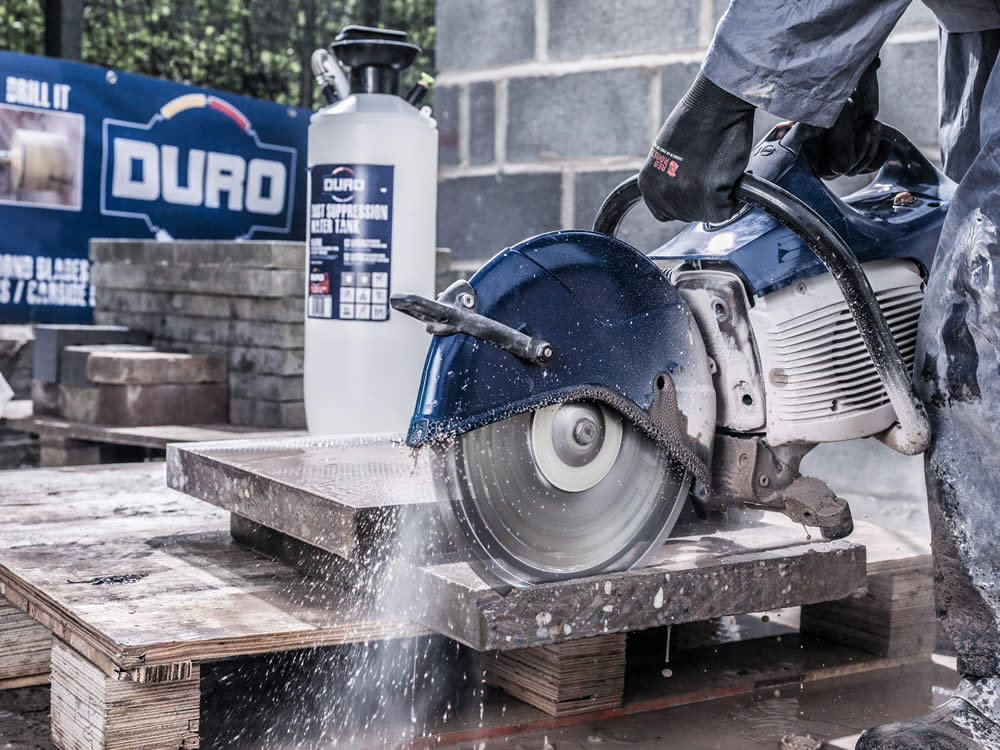
DURO Universal Laser-Welded Wet & Dry Blades
Our flagship commercial range featuring 12mm to 15mm segment heights, keyhole stress-relief slots, and an all-material cobalt matrix bond. Designed for cutting hard concrete, engineering brick, kerb stones, and masonry with or without water suppression tanks.
Inquire for Bulk Wholesale Specifications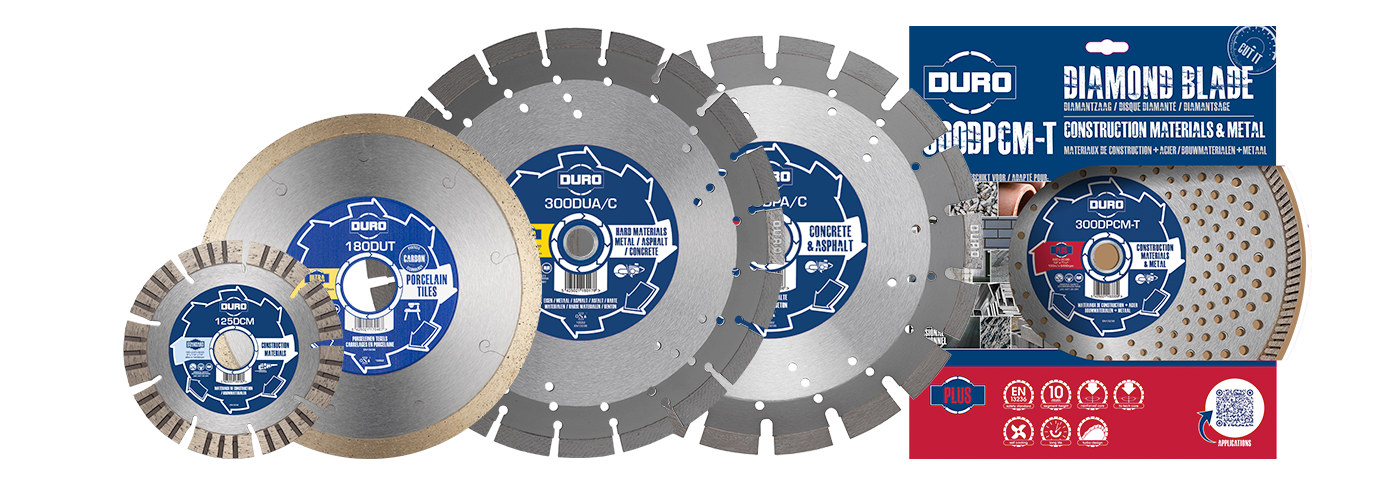
Multi-Tiered Performance Series
Four tailored tiers (Entry, Standard, Professional, and Ultra-Premier) allowing hire companies and distributors to align consumable costs directly with expected cutting distances.
Contact Us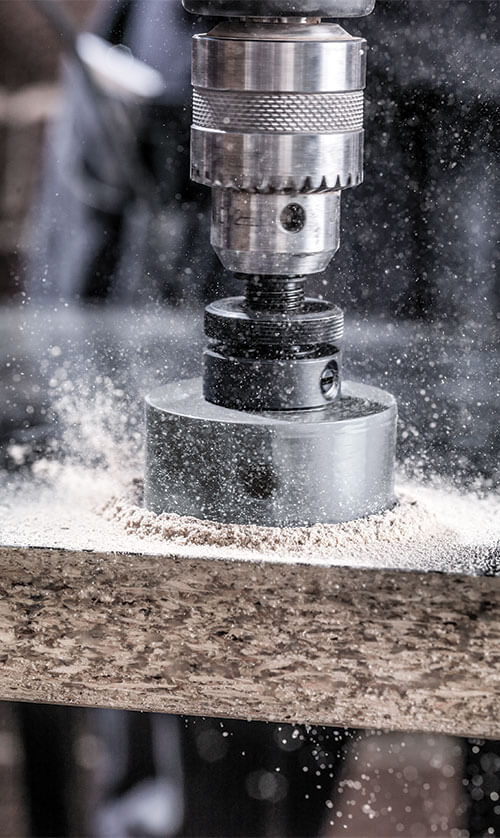
Thin-Kerf Precision Dry Blades
Continuous-rim turbo geometries for ultra-hard porcelain, ceramic, and natural marble slabs. Zero-chipping edge retention engineered for dry angle grinder application.
Contact Us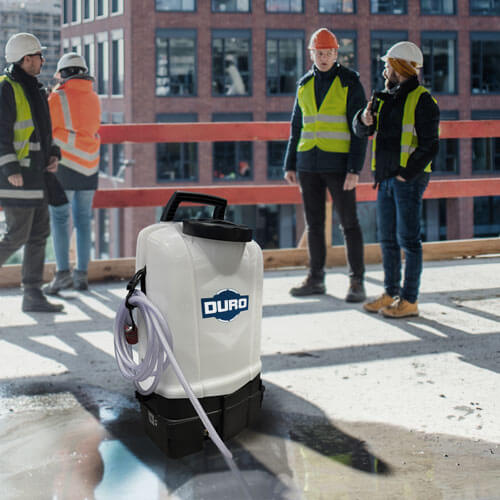
Integrated Dust Control Systems
Paired directly with our 10L–60L battery-powered pressurized water tanks to turn dry-cutting hand-held saws into fully compliant wet-cutting silica extraction units on remote job sites.
Contact Us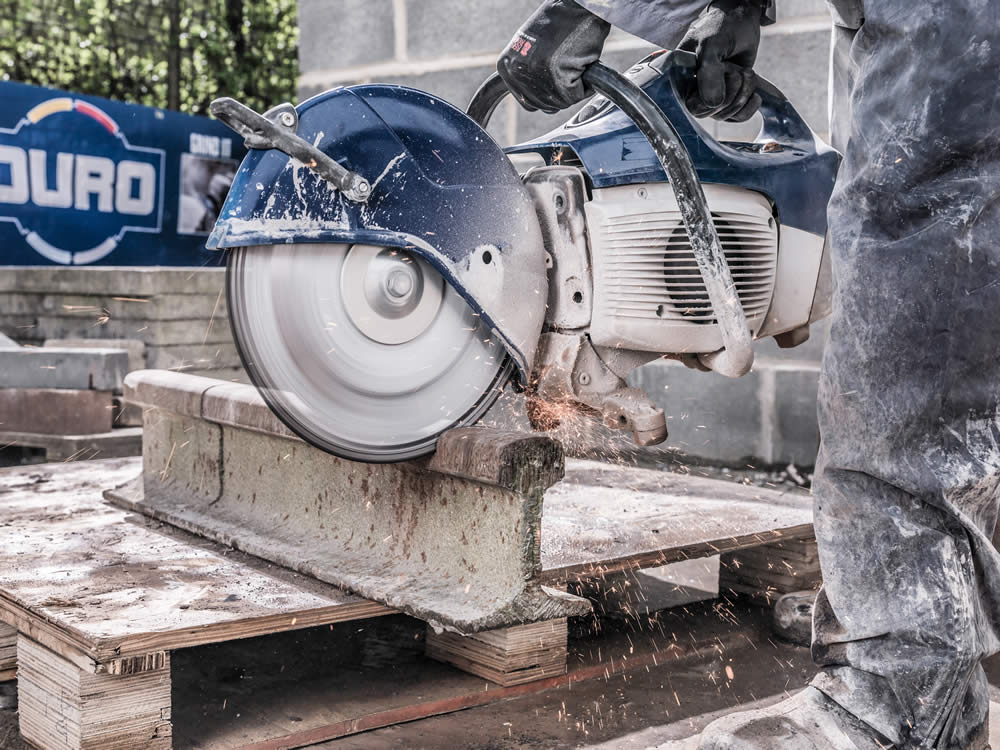
Vacuum Brazed Metal & Rescue Blades
Engineered with exposed single-layer vacuum brazed diamond matrix for emergency rescue, structural steel, ductile iron, and rebar cutting without segment shear risks.
Contact UsEnterprise Sourcing Value
Why Global Distributorships & Industrial Hire Fleets Partner with DURO
DURO Yokota Ltd brings over 20 years of field-proven domain expertise, combining 150+ years of collective internal diamond tooling engineering experience. We don't just supply diamond consumables—we analyze site substrates, machine RPM speeds, torque delivery profiles, and regional dust containment mandates to provide high-performing tooling packages.
Our four core ISO accreditations guarantee that every batch of wet and dry diamond blades delivered to your distribution center adheres to strict quality controls, occupational safety protocols, environmental practices, and secure data handling standards.
oSa Safety Certification
Manufactured strictly in oSa member factories, fully compliant with EN 13236 safety standards for superabrasives.
Dual-Warehouse Inventory
Deep stock profiles ensuring rapid dispatch, zero backorder delays, and optimized container fulfillment for export markets.
Material Matching Matrix
Four distinct performance tiers tailored to match exact contractor budgets and required total meters cut.
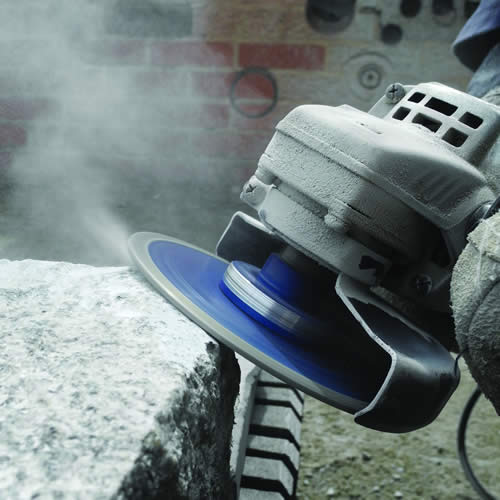 Surface Prep Tooling
 Macro Sourcing Trends
Future Procurement Trends in Wet and Dry Diamond Tooling (2026–2030)
As AI-driven construction logistics, stringent health and safety regulations, and sustainable building materials reshape the industry, procurement officers must prepare for several emerging technological shifts in the diamond consumable sector:
Trend 01: High-RPM Cordless Saw Optimization
Battery-Optimized Thin-Kerf Segment Geometries
The rapid transition from petrol-driven disc cutters to 72V/120V battery-powered cut-off saws requires fundamental changes in blade design. Cordless saws generate instantaneous torque but operate under strict battery draw constraints. Next-generation wet and dry diamond blades feature ultra-thin steel cores (down to 1.8mm) and narrow-kerf segmented matrices that decrease resistance against concrete and masonry by up to 35%, significantly extending battery run-times per charge.
Trend 02: RCS Regulations & Smart Water Feed
Mandatory Silica Suppression Integration
Global regulatory agencies (including OSHA in the US and HSE in Europe) are continually reducing allowable Workplace Exposure Limits (WEL) for Respirable Crystalline Silica (RCS). Sourcing managers are shifting away from standalone dry blades toward complete wet-and-dry ecosystem kits that bundle diamond blades directly with battery-powered mobile water feed tanks, ensuring full compliance across all residential and civil project environments.
Trend 03: Metallurgical Matrix Innovations
3D Structured Diamond Placement (Arix Technology)
Random diamond particle distribution in conventional segments leads to inconsistent wear rates and erratic cutting speeds. Future-proof procurement focuses on structured 3D diamond arrays, where synthetic diamond crystals are arranged in uniform grids throughout the metallic matrix. This delivers consistent cutting speeds, lowers operating vibrations, and increases total blade life by up to 50% compared to standard hot-pressed segments.
Trend 04: Circular Economy & Core Recycling
Eco-Compliant Manufacturing & Core Re-Brazing
With environmental compliance taking center stage under ISO 14001 guidelines, large contractors and rental fleets now mandate zero-landfill procurement goals. Top-tier wet and dry diamond blade manufacturers are providing stress-relieved steel cores designed for segment stripping and automated laser re-welding, alongside 100% recyclable cardboard packaging programs.
Contact UsTechnical Sourcing Knowledge Base
Frequently Asked Procurement & Application Questions
Comprehensive technical answers to common queries asked by global buyers, structural engineers, and site managers regarding Wet and Dry Diamond Blades.
A diamond blade specifically designed for wet-only cutting MUST NOT be used dry. Wet-only blades typically utilize high-frequency silver brazing to attach segments to the core. Without water cooling, temperatures quickly exceed the melting point of silver solder (~350°C), causing segment detachment and severe safety hazards. Conversely, dry-capable diamond blades (laser-welded) can safely be used wet. Using water on a laser-welded dry blade actually extends segment life, reduces airborne dust, and improves cut speed by continuously flushing abrasive slurry out of the kerf.
Segment loss during dry cutting occurs due to thermal degradation or mechanical impact with structural steel rebar. To prevent segment loss: (1) Ensure the blade is explicitly certified as laser-welded with a micro-keyhole stress slot design; (2) Practice "step-cutting"—making multiple shallow passes of 25mm–35mm depth rather than a single deep cut; (3) Allow the blade to idle out-of-cut every 30 to 45 seconds to let ambient air stream through the gullets and cool the core; and (4) Verify that the arbor flanges are clean, flat, and torqued to machine specification.
The core rule of diamond matrix metallurgy is: Opposites Attract. Soft, highly abrasive materials (such as green concrete, asphalt, soft sandstone, and breeze blocks) require a hard metal matrix bond (high cobalt/tungsten carbide ratio) to resist erosion. Hard, dense materials (such as flint aggregate concrete, engineering brick, granite, and hard porcelain) require a soft metal matrix bond (bronze/copper matrix) that wears away smoothly to constantly expose fresh, sharp synthetic diamond edges.
For European and North American B2B distribution, diamond blades must comply with EN 13236 (Safety Requirements for Superabrasive Products). Furthermore, buyers should prioritize manufacturers holding oSa (Organisation for the Safety of Abrasives) certification. oSa members undergo regular independent plant audits covering segment shear testing, side-load core testing, bursting speed verification, and metallurgical quality consistency. Operations should ideally be certified to ISO 9001 (Quality), ISO 14001 (Environmental), ISO 45001 (Safety), and ISO 27001 (Data Security).
Glazing occurs when a blade with a bond that is too hard is used on extremely dense material without water. The exposed synthetic diamonds wear flat, and the metal matrix does not erode fast enough to release new sharp diamonds. The blade spins without cutting, creating excessive heat and noise. To re-dress a glazed blade, make 3 to 5 cuts into an extremely abrasive material such as soft sandstone, asphalt, or a dedicated silicon carbide dressing brick. This quickly strips away the top layer of hardened metal bond, exposing fresh diamond edges.
An incorrect arbor fitment causes radial runout (eccentric spinning), creating severe machine vibration, uneven segment wear, egg-shaped bore deformation, and premature core cracking. Common industrial arbor sizes include 20mm (handheld disc cutters), 22.23mm (7" and 9" angle grinders), and 25.4mm / 50mm (floor saws). Always use precision-machined reduction rings supplied directly by the manufacturer if adapting arbor sizes, and never operate a blade with an oversized bore fitting.
Total Cost Per Meter (TCPM) is the true financial metric for commercial consumable sourcing, calculated as: TCPM = (Initial Blade Cost + Operator Labor Cost during Blade Changes) ÷ Total Linear Meters Cut. A premium $80 blade cutting 250 meters yields a raw consumable cost of $0.32/meter. A budget $30 blade cutting only 50 meters yields $0.60/meter—plus requires five times as many machine downtime events for blade replacements. High-yield laser-welded blades dramatically lower overall job costs despite higher initial purchase prices.
DURO water suppression tanks feature standard quick-release brass hose couplings that attach directly to on-tool water feed manifolds on major power tool brands. Our 20L and 60L battery-powered site tanks deliver continuous, regulated water pressure (up to 3.5 bar) without requiring manual pumping, providing steady water delivery to suppress silica dust at the blade kerf during remote cutting operations.
Partner With DURO Yokota
Upgrade Your Industrial Diamond Consumable Inventory Today
Whether you are seeking custom OEM private-label manufacturing, expanding your commercial stockist network, or outfitting a national equipment hire fleet with oSa-certified wet and dry diamond blades, our engineering team is ready to deliver tailored solutions.
Stay Informed
Subscribe To Receive All The Latest News
New product launches, application guides and technical updates for construction and industrial professionals.
We respect your inbox. Product and technical updates only.