
Industrial Machinery & Diamond Tooling Guide
STONE BRIDGECUTTING SAWSENGINEERING &PROCUREMENT
The definitive B2B buyer manual for high-precision 4-axis and 5-axis Stone Bridge Cutting Saws. Discover performance metrics, structural engineering criteria, diamond blade matrix selection, silica control, and total cost of ownership (TCO) benchmarks.
Executive B2B Purchasing Insights
Architectural Precision & Machinery Specification Matrix
Global stone fabricators, civil engineering contractors, and machinery buyers face escalating demands for processing speed, material versatility, and strict silica dust compliance. This operational guide details everything required to select, specify, and deploy industrial Stone Bridge Cutting Saws.
1. Structural Architecture: Monoblock vs. Heavy-Duty Gantry Split-Frame Saws
When procuring Stone Bridge Cutting Saws, the primary engineering choice centers on structural framing. Modern stone fabrication demands absolute rigidity to absorb torsional vibration caused by high-torque diamond saw spindles cutting dense substrates like ultra-compact sintered stone, quartzite, and granite slabs.
Monoblock Bridge Saws: Designed with an integrated heavy-duty steel frame, monoblock units require zero permanent concrete foundation pits. They can be relocated via overhead crane or heavy forklift within hours. Monoblock architecture provides exceptional thermal stability and vibration damping for slab processing up to 3500mm x 2000mm. They are ideal for medium-to-high volume countertop workshops requiring fast deployment.
Gantry Split-Frame Bridge Saws: Engine-built for massive structural masonry, thick stone block slabbing, and multi-shift industrial processing. Split-frame systems mount directly to reinforced concrete side-walls. This setup permits blade diameters from 600mm to 1200mm+, achieving cutting depths exceeding 450mm per pass while eliminating deflection over 6-meter span bridge beams.
Technical Performance Specification Comparison Matrix
Compare key operational capabilities across our core industrial bridge cutting saw configurations:
| Performance Parameter | 4-Axis Monoblock Saw | 5-Axis CNC Bridge Saw | Heavy Gantry Block Saw |
|---|---|---|---|
| Primary Application | Straight, Miter & Sink Cuts | Complex Curves, 3D Sculpting & Miters | Dimensional Block & Architectural Stone |
| Blade Diameter Range | 350mm – 500mm | 400mm – 625mm | 600mm – 1200mm |
| Spindle Power Rating | 11 kW to 15 kW (15–20 HP) | 15 kW to 22 kW (20–30 HP) | 22 kW to 37 kW (30–50 HP) |
| Positioning Accuracy | ±0.15 mm | ±0.05 mm | ±0.20 mm |
| Table Tilt & Rotation | 0°–85° Hydraulic Tilt / 0°–360° Auto | 0°–85° Hydraulic Tilt / 0°–360° Interpolated | Fixed or Motorized Heavy Bogie Table |
| Water Feed Requirement | 30 – 50 L/min (Continuous Feed) | 40 – 70 L/min (Internal & External) | 80 – 150 L/min High-Volume Recirculation |
| Control & Software | Touchscreen PLC / Parametric Cuts | CAD/CAM Vision System & Vein Match | Industrial CNC / PLC Programmed |
2. Kinematics, Interpolation & Spindle Motor Dynamics
Modern stone processing has moved far beyond simple 2D straight cutting. Procurement officers must evaluate spindle dynamics, encoder resolutions, and linear guide systems to ensure long-term ROI.
- 5-Axis Interpolation: Features fully interpolated X, Y, Z axes combined with rotating (C-axis) and tilting (A-axis) head movement. This enables complex compound miters, arc profiling, recessed drainboard milling, and automatic 45-degree corner plunge-cutting without manual slab movement.
- Variable Frequency Drives (VFD Spindles): Stone substrates require dramatically different peripheral rim speeds (m/s). Natural Marble typically cuts efficiently at 35–45 m/s, whereas hard quartzite and Dekton require reduced speeds of 20–28 m/s with increased torque to prevent segment glazing or edge chipping. Advanced VFD spindles allow automatic RPM adjustment based on material library presets.
- Linear Motion & Lubrication: Premium bridge saws utilize Japanese or European Recirculating Roller Linear Guides on all primary axes, driven by precision helical rack-and-pinion assemblies. Automatic centralized oil lubrication systems are crucial to purge micro-abrasive stone slurry from bearing blocks.
The DURO Advantage
Tooling & Machinery Synced For Maximum Output
A high-performance stone bridge cutting saw is only as productive as the diamond tooling mounted on its spindle. DURO engineers both high-stability diamond blades and surface preparation equipment engineered to withstand intense continuous duty.
All DURO diamond consumables utilized on bridge saws and site machinery are manufactured in oSa (Organization for the Safety of Abrasives) member facilities. This guarantees structural segment integrity, strict EN 13236 compliance, and protection against high-speed core fracture.
Precision Silent-Core Technology
Laminated copper-steel cores reduce operational noise by up to 15 dB on bridge saw cutting lines.
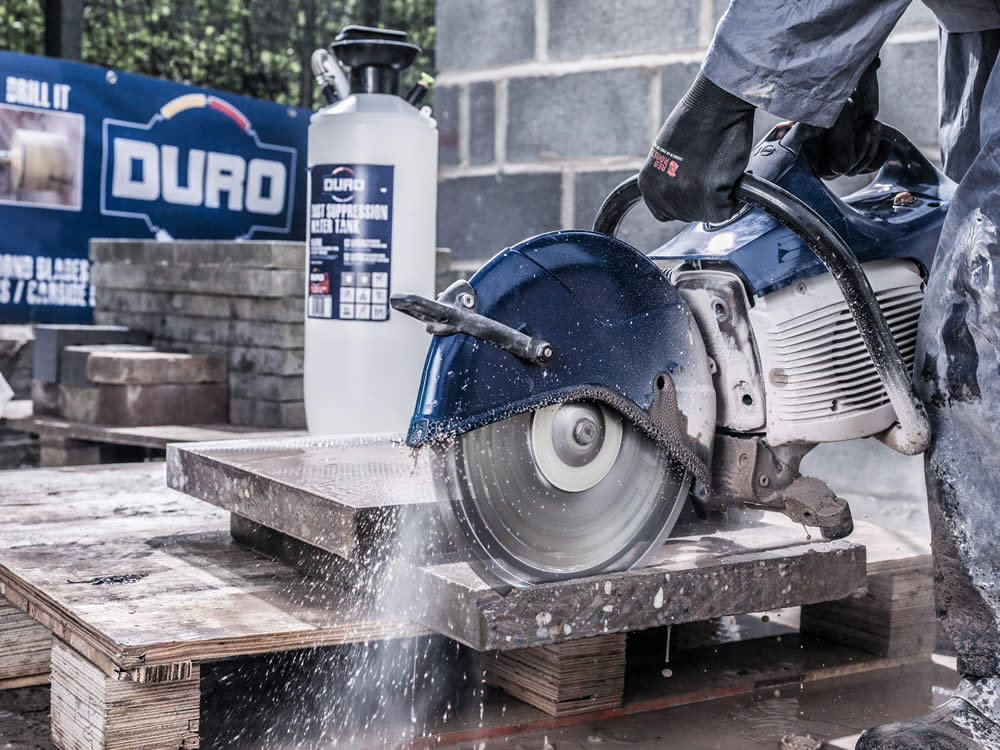 Diamond Blades
  Dust Suppression
 Material-Matched Bonds
Formulated matrix bonds engineered specifically for Class I Soft Marbles through Class IV Hard Quartzites.
Curated B2B Product Lineup
Recommended Stone Bridge Cutting Saws & Tooling Systems
Explore our field-tested machinery and diamond blade solutions optimized for high-capacity fabrication plants and structural masonry projects.
DURO MasterCut 5-Axis CNC Bridge Saw System
Heavy monoblock construction with integrated overhead camera vision system for digital vein-matching. Features 18.5 kW inverter spindle, 0°-90° tilting head, and interpolated 5-axis motion for flawless miters, cutouts, and profiling.
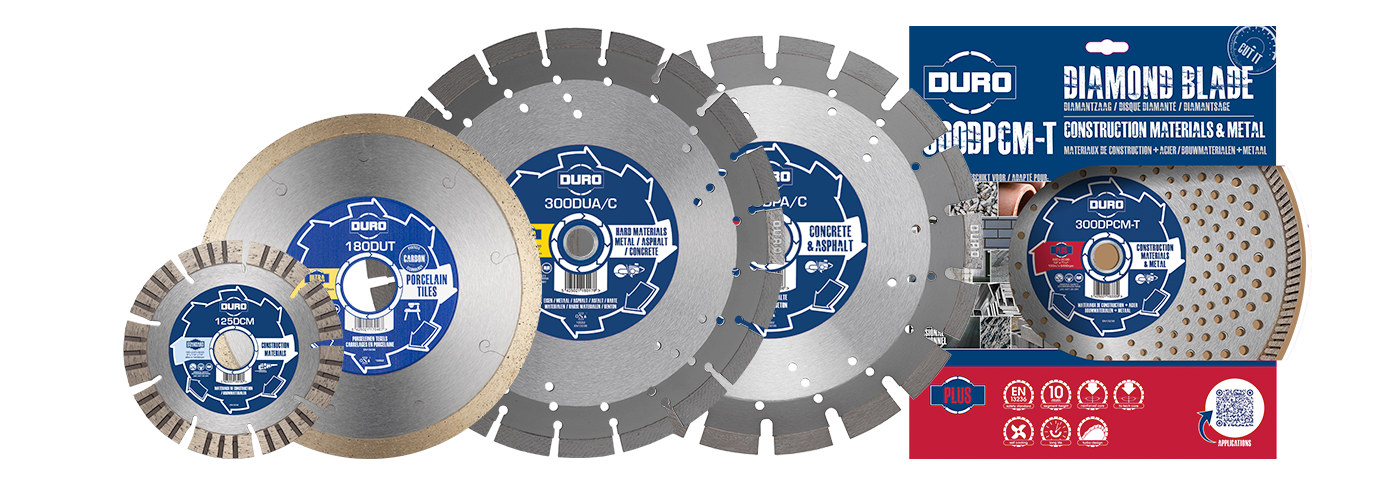
Silent-Core Granite Bridge Saw Blades
350mm - 600mm sandwich silent core diamond blades with arrayed diamond segment technology. Designed for fast cutting speeds in hard engineered stone.
Industrial Slurry & Dust Management Unit
Closed-loop water recirculation filtration system ensuring uninterrupted high-pressure water delivery to bridge saw blades while eliminating airborne silica.
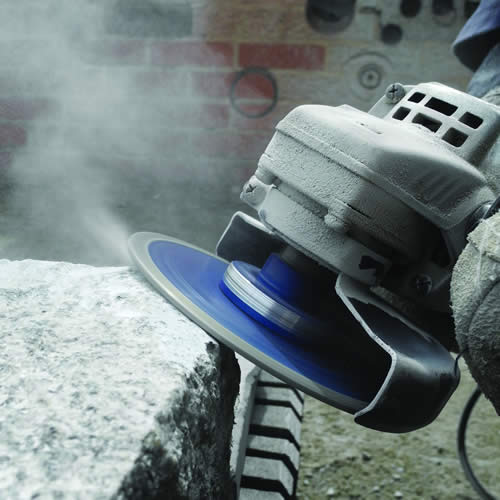
CNC Diamond Milling & Profiling Tools
Gas thread finger bits, stub routers, and calibration rollers designed to pair with 5-axis bridge saw half-inch gas auxiliary connections.
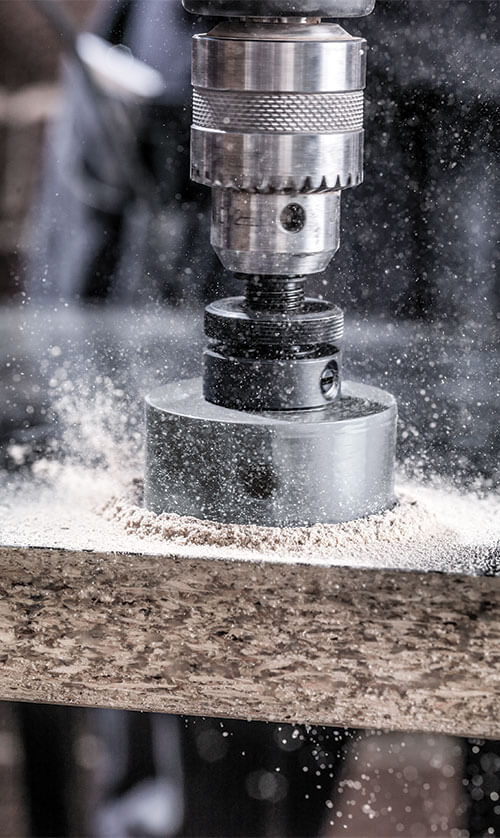
Vacuum Brazed CNC Core Bits
Fast-drilling vacuum brazed core drills for initiating sink cutouts and mounting holes on CNC bridge saw tables without edge blowout.
Industry Analysis & Future Outlook
Future Procurement Trends in Stone Bridge Cutting Saws (2026–2035)
How artificial intelligence, material evolution, and global health regulations are reshaping the stone machinery investment landscape.
Trend 1: AI-Driven Vision Systems & Automated Vein Matching
Procurement departments are rapidly shifting away from manual bridge saws toward fully automated optical nesting systems. High-resolution overhead cameras capture slab photographs, detect natural fissures and surface defects, and instantly project optimized CAD cut patterns onto the material. Algorithms automatically align complex veins across kitchen island tops and waterfall splashbacks, reducing material scrap by up to 18% per slab.
Trend 2: Transition to Sintered Ultra-Compact Surfaces (Dekton & Porcelain)
The global surge in porcelain and ultra-compact sintered stone slabs has created significant tooling challenges. Traditional granite blades cause catastrophic edge chipping on tensioned porcelain slabs. Future-ready bridge saws must feature ultra-smooth linear drives with zero backlash, combined with diamond blades incorporating soft, fast-wearing matrix bonds paired with high diamond concentration (grade A synthetic monocrystalline diamonds).
Trend 3: Strict Crystalline Silica Dust Legislation & Closed-Loop Hydronics
Regulatory bodies worldwide (such as OSHA in the USA and HSE in the UK) have imposed rigid limits on Respirable Crystalline Silica (RCS). Modern bridge saw procurement requires integrated zero-emission wet-cutting enclosures, high-pressure internal spindle water feeds, and automated slurry treatment plants. Facility managers are prioritizing equipment that minimizes water consumption through dynamic flow-adjustment valves synchronized with blade engagement.
Trend 4: IoT Diagnostics, Predictive Maintenance & Cloud Telemetry
Industrial IoT sensors embedded within bridge saw spindles and linear axis drive motors continuously monitor vibration frequency, spindle temperature, current draw, and total cutting meters. Machine control units communicate with cloud diagnostics platforms, predicting spindle bearing fatigue and blade glaze before structural failure occurs, thereby preventing unbudgeted factory downtime.
Financial & Operations ROI
Total Cost of Ownership (TCO) & ROI Calculation for B2B Procurement
When assessing a capital expenditure investment in high-performance Stone Bridge Cutting Saws, smart procurement teams look beyond the initial FOB machine purchase price. Operational profitability depends heavily on the total cost per cut meter over a 5-to-10-year service lifecycle.
Total Cost = Purchase Price + (Energy Consumption × Hours) + (Diamond Tooling Cost / Meter Cut) + Maintenance Down-Time + Material Scrap Loss - Salvage Value
Key ROI Drivers:
- Cutting Speed vs. Labor Rate: A 5-axis CNC bridge saw processing at 3.5 meters/minute reduces direct operator labor cost per countertop by over 65% compared to manual manual rail saws.
- Material Scrap Reduction: Integrated CAD/CAM camera nesting minimizes offcut waste. Saving just 1.5 slabs of premium quartzite per week yields an annual material cost savings exceeding $25,000 USD.
- Spindle Efficiency & Power Factor: Modern VFD premium-efficiency IE3/IE4 motors draw up to 22% less kWh energy during heavy cutting cycles while preventing thermal overload.
- Diamond Blade Longevity: Pairing a rigid bridge frame with oSa-certified silent-core diamond blades extends segment wear life by up to 35%, dramatically reducing consumable costs per lineal meter cut.
World-Class Manufacturing
Why Global Buyers Partner with DURO

DURO combines over 20 years of field-tested tooling development with rigid ISO-accredited quality control systems. We support machinery distributors, large fabrication plants, and civil engineering companies worldwide with unmatched stock depth and application engineering expertise.
Quality & Compliance
Audited Enterprise Capabilities
- 01ISO Management Accreditations
Certified to ISO 9001 (Quality), ISO 14001 (Environmental), ISO 45001 (Occupational Health & Safety), and ISO 27001 (Information Security).
- 02oSa Safety Member Manufacturing
Consumables produced under audited oSa membership meeting strict EN 13236 safety standards for high-speed cutting blades.
- 03Application & Material Testing
Every blade matrix and machine pairing is rigorously field-tested on live site substrates before inclusion in our catalog.
- 04Rapid Global Logistics Depth
Deep inventory across primary distribution hubs guarantees rapid dispatch and minimal operational downtime for your fleet.
Procurement Knowledge Base
Frequently Asked Questions: Stone Bridge Cutting Saws
Expert solutions to common global buyer queries regarding machine selection, maintenance, blade pairing, and operational compliance.
A 4-axis bridge saw features automated motion along the X, Y, and Z linear axes, along with automated rotation of the blade cutting head (C-axis) up to 180° or 360°. It is ideal for straight, plunge, and right-angle miter cuts. A 5-axis bridge saw adds a fully interpolated tilting spindle head (A-axis, 0° to 90° or 180°), allowing the machine to perform complex 3D surface sculpting, curved miter cuts, sink cutouts, arc profiling, and complex architectural moldings without re-positioning the slab.
Blade speed is dictated by substrate hardness and blade diameter. Peripheral speed (m/s) = (π × Blade Diameter in meters × RPM) / 60. Soft marbles cut optimally at 35–45 m/s (approx. 1900–2400 RPM for a 350mm blade). Hard granites require 25–35 m/s (1350–1900 RPM). Ultra-hard quartzites and sintered porcelain slabs require reduced speeds of 20–28 m/s (1100–1500 RPM) paired with a high water feed rate to prevent diamond segment glazing and edge chipping.
Most commercial stone bridge cutting saws require a 3-Phase 380V/415V/480V AC power supply at 50Hz/60Hz. Spindle main motors typically draw between 11 kW (15 HP) and 22 kW (30 HP), with total machine power requirements (including servo motors, hydraulic table pumps, and vacuum lifters) ranging from 18 kW to 32 kW. A dedicated circuit breaker rated for 63A to 80A with surge protection is standard.
Silent-core diamond blades feature a laminated sandwich core structure consisting of two steel sheets separated by a thin copper or damping alloy foil. This construction absorbs high-frequency acoustic resonance created during continuous cutting, reducing ambient shop noise by 10 to 15 decibels (dB). In addition to improving workplace safety compliance, silent cores reduce micro-vibrations, yielding cleaner cut edges and longer diamond segment life.
Water delivery directly to both sides of the diamond segment acts as an immediate suppression fluid, capturing silica dust particles at the exact point of micro-fracture before they become airborne respirable crystalline silica (RCS). Continuous wet cutting maintains dust levels well below global regulatory exposure limits (such as OSHA's PEL of 50 µg/m³ 8-hour TWA). Additionally, water flushes abrasive slurry out of the kerf, cooling the steel core to prevent warping.
Yes, provided the saw is engineered with high structural rigidity, zero-backlash linear guides, and a variable frequency drive (VFD). Sintered ultra-compact slabs harbor high internal tension. Successful processing requires reducing entry and exit feed rates by 50%, using a dedicated soft-bond silent blade designed specifically for sintered stone, maintaining continuous clean water flow (at least 40 L/min), and ensuring a perfectly flat, rubber-topped cutting table.
Daily maintenance involves cleaning stone slurry from linear guide tracks and greasing rack-and-pinion gears. Weekly checks include inspecting spindle arbor runout (must remain under 0.02mm), verifying water pressure filters, and checking hydraulic fluid levels. Monthly routines require inspecting bridge parallelism, re-calibrating camera vision software, and checking line laser alignment across the table X/Y grid.
DURO supports international buyers and distributor networks with comprehensive machinery warranties, full technical documentation, CAD/CAM software training modules, and remote IP-connected diagnostic support. Strategic spare parts packages (including replacement spindle belts, linear bearings, solenoid valves, and sensor switches) are stocked for immediate dispatch from our centralized logistics centers.
Ready to Upgrade Your Stone Processing Infrastructure?
Request a Custom Quotation & Technical Consultation
Contact our senior engineering team today to discuss custom machinery configurations, diamond blade volume pricing, and international delivery schedules.
Stay Informed
Subscribe To Receive All The Latest News
New product launches, application guides and technical updates for construction and industrial professionals.
We respect your inbox. Product and technical updates only.