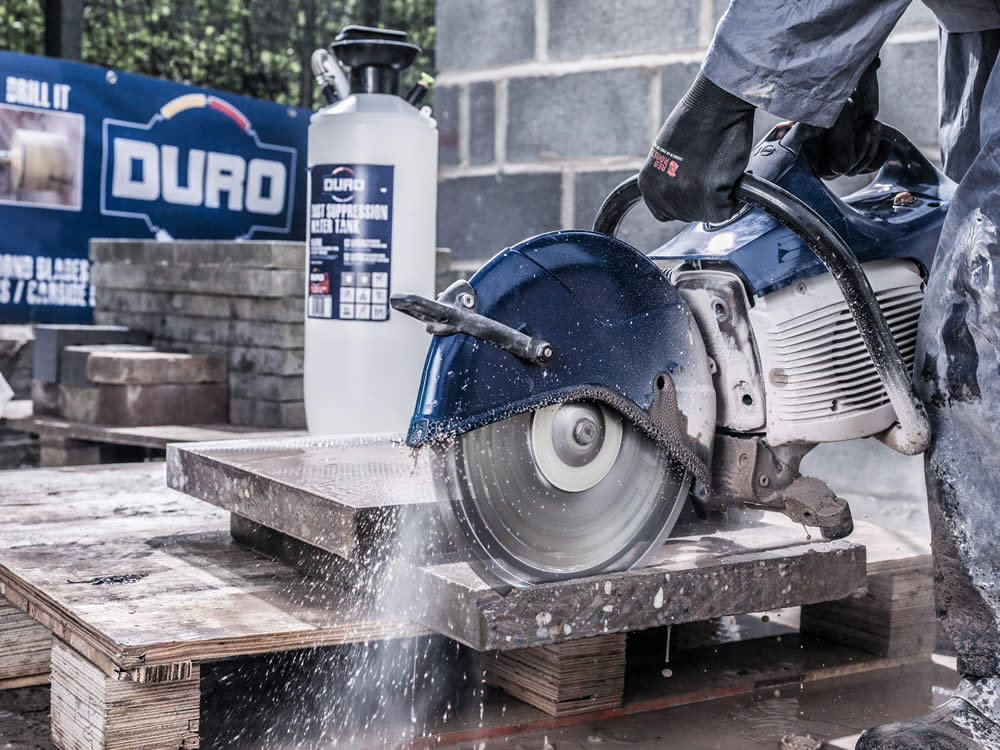
1. Motor Dynamics and Multi-Blade Slotting Mechanics
Electric wall chasers are specialized heavy-duty power tools engineered to cut precise parallel channels into tough masonry walls—including dense reinforced concrete, hard engineering brick, hollow cinder blocks, and lime-cement render. Unlike standard angle grinders fitted with dust shrouds, purpose-built wall chasers incorporate dual-spindle or multi-blade arbor configurations driven by high-torque motors ranging from 1,800 Watts to over 3,000 Watts.
The mechanical efficiency of a wall chaser depends on maintaining a linear peripheral cutting velocity between 45 m/s and 80 m/s. When cutting simultaneously with twin twin-diamond discs, the motor must handle dual-friction drag without thermal tripping. Premium suppliers incorporate constant-electronics controllers, soft-start torque limiters, and mechanical slip clutches to protect both the operator and gear train during sudden blade pinch in reinforced rebar.
Twin-Blade vs. Multi-Disc Breakout Slotting
Standard twin-blade wall chasers create twin parallel score lines, leaving a solid center core that requires manual removal using an SDS hammer chisel. Advanced 5-blade setup chasers cut the complete channel width in a single pass by milling the interior concrete core into micro-aggregates, eliminating the secondary hammering phase completely and accelerating installation times by up to 65%.
Substrate Resistance & Torque Vectoring
Variations in aggregate hardness—such as river gravel vs. crushed basalt—exert non-uniform loads across the blade face. Specialized wall chaser gearboxes feature dual-stage planetary reduction gears engineered with case-hardened alloy steel to prevent rotational stall under heavy down-force pressures.
2. Diamond Segment Metallurgical Bond Matrix Selection
The operational efficiency and economic life of wall chaser diamond blades depend on matching the segment's metallic bond matrix to the physical hardness and abrasiveness of the target substrate. Diamond segments consist of high-purity synthetic diamond grit suspended within a sintered matrix of cobalt, nickel, copper, and iron powders.
| Substrate Classification | Material Examples | Recommended Bond Hardness | Diamond Grit Mesh Size | Laser Weld Strength |
|---|---|---|---|---|
| Hard & Dense Non-Abrasive | Reinforced Concrete, Granite, Hard Brick | Soft Cobalt Matrix (B10 - B20) | 40 / 50 Mesh (High Friability) | > 2,500 Nm Torsional Shear |
| Medium-Hard Standard | Cinder Block, Standard Clay Brick, Mortar | Medium-Hard Alloy Matrix (B40 - B50) | 30 / 40 Mesh (Balanced) | > 2,200 Nm Torsional Shear |
| Soft Highly Abrasive | Aerated Autoclaved Concrete (AAC), Plaster, Sandstone | Ultra-Hard Bronze/Tungsten Matrix (B70+) | 20 / 30 Mesh (Coarse Grit) | > 2,000 Nm Torsional Shear |
When cutting hard reinforced concrete, a soft bond matrix is required. As the outer synthetic diamond particles wear down and dull, the soft metallic matrix erodes at an equivalent rate, continuously exposing fresh, sharp diamond edges to the substrate. Conversely, when slotting abrasive materials like AAC or green plaster, a hard metal bond is essential to prevent premature matrix erosion and premature diamond shed.
3. Silica Dust Mitigation & Compliance (OSHA & EU Standards)
Wall chasing generates immense quantities of Respirable Crystalline Silica (RCS) dust. RCS particles are finer than 2.5 microns, posing extreme respiratory risks including silicosis and chronic obstructive pulmonary disease (COPD). Worldwide regulatory bodies—including OSHA in the United States (29 CFR 1926.1153 Table 1) and HSE in the UK—strictly enforce engineering controls on all mechanical slotting equipment.
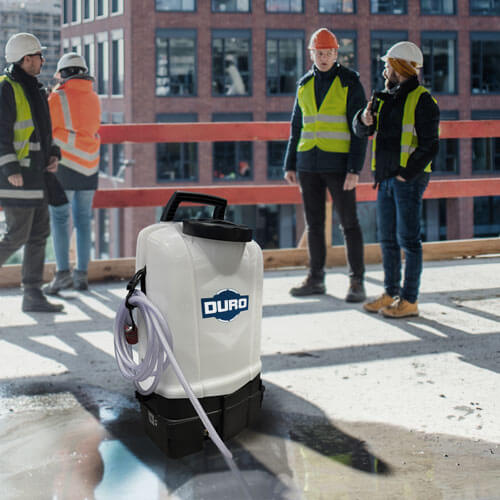
Integrated Vacuum Shrouds & Dust Suppression Bowsers
Professional wall chasers must feature fully enclosed plunger shrouds with rubber perimeter seals that maintain negative pressure against the wall surface throughout the plunge and cutting cycle. Dust extraction systems must connect to M-Class or H-Class industrial dust extractors equipped with auto-filter cleaning mechanisms.
For wet-cutting wall chasing operations, our 20L to 60L battery-powered dust suppression water tanks deliver constant pressurized fluid directly to the cutting channel, binding microscopic silica dust at the point of creation without requiring manual hand pumping.