In 2026, Stone Bridge Cutting Saws are becoming more precise, connected, and application-specific. Fabricators now compare machines by more than blade diameter. They examine cutting accuracy, water control, table strength, software, and service access. A polished granite slab may need a different setup than a thick limestone stair tread. Small differences matter.
Fred M. Hueston, a respected stone-care educator and industry consultant, has offered a useful reminder: “Every stone has a story, and every repair should respect it.” That principle also applies to cutting. The right saw should protect the material while meeting production demands. This guide examines bridge saws, CNC bridge saws, five-axis models, compact machines, and automatic production systems. Each type has practical strengths. Each also has limits.
A five-axis saw can create complex sink cutouts and angled edges. A standard bridge saw may deliver better value for repeated straight cuts. A compact model can suit a small workshop, but its worktable may restrict large slabs. Water recycling reduces waste, although poorly maintained systems can affect blade performance. That detail is easy to overlook.
Real workshop experience remains essential. Dust, vibration, operator training, and replacement-part availability can change the buying decision. Specifications alone are not enough. Sometimes, the most advanced machine is the wrong machine. This overview helps readers compare the leading Stone Bridge Cutting Saws for accuracy, durability, safety, and long-term operating value. It also leaves room for honest doubt, because stone is never perfectly predictable.
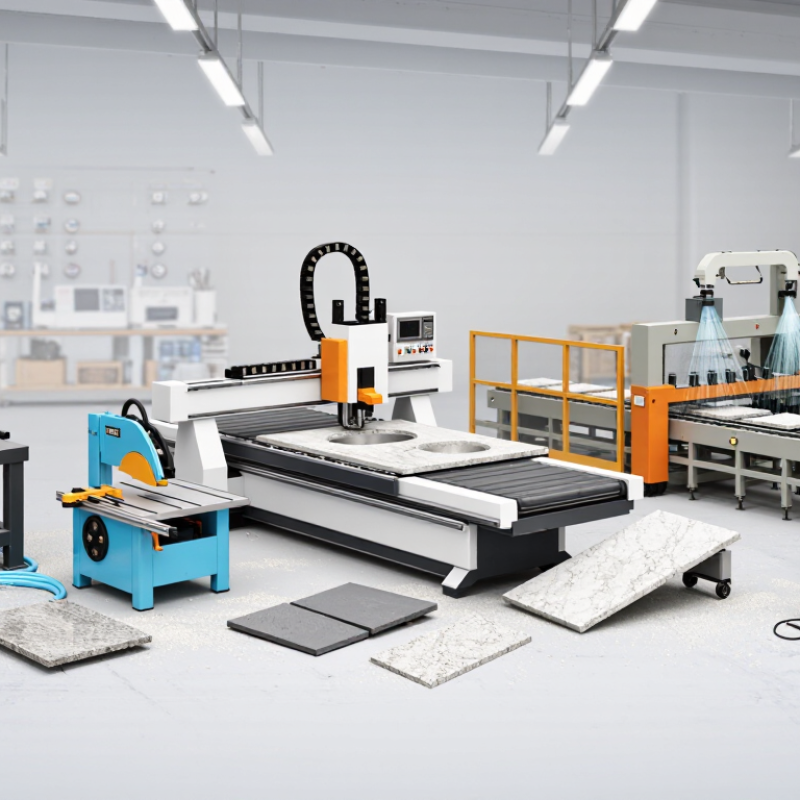
Stone bridge cutting saws are fixed machines with a diamond blade mounted on a moving bridge. The bridge travels along rails, while the worktable supports granite, marble, quartzite, or porcelain slabs. Water cools the blade and suppresses dust during cutting. Most systems include a motorized head, adjustable cutting depth, and a tilting table for mitre work.
Their main types include manual, semi-automatic, and CNC bridge saws. Manual models depend heavily on operator alignment. Semi-automatic machines repeat straight cuts with better consistency. CNC versions control movement, rotation, and bevel angles through programmed coordinates. Five-axis systems add more flexibility for curved edges and complex sinks. They are productive, but programming errors remain possible.
Grand View Research’s 2024 stone-cutting-machine analysis identifies construction renovation and fabricated surfaces as important demand areas. The report also describes automation as a major efficiency driver. In the United States, the USGS Mineral Commodity Summaries 2025 reports dimension-stone production at roughly 1.5 million metric tons in 2024. That volume does not measure bridge-saw sales, but it shows the material base these machines serve.
In practical use, accuracy depends on more than the machine. A worn rail can shift a cut by a few millimeters. That small error may ruin an expensive slab. CNC is not automatically better. Operators still need blade knowledge, stone inspection, water-flow checks, and careful calibration. I have found the weakest point is often preparation, not cutting speed.
In 2026, stone bridge cutting saws are defined by accuracy, rigidity, and safer workflow control. Four-column bridge saws remain practical for marble, granite, and engineered stone. Their reinforced frames reduce vibration during long, straight cuts. They suit workshops processing heavy slabs daily. A well-adjusted water system also keeps diamond blades cooler and limits airborne dust.
CNC bridge saws offer automated cutting, shaping, and repeated production. They are useful for countertops, stair parts, and detailed edge profiles. Digital positioning improves consistency, but operators still need to verify slab measurements manually. Software cannot correct a warped slab or an incorrectly marked template. That small oversight can waste valuable material.
Monorail bridge saws provide a simpler structure and often require less floor space. They work well for basic crosscuts and moderate workshop volumes. Portable bridge saws are easier to relocate between cutting areas, although their compact frames may feel less stable on thick stone.
I have found that setup quality matters as much as machine type. Level the rails, inspect blade wear, and test one spare piece before production. Do not rush this step. Noise, uneven edges, and coolant splashing often reveal problems early. Choosing the best type depends on stone hardness, slab dimensions, cutting frequency, available space, and the operator’s technical experience.
In 2026, stone bridge cutting saws depend on more than blade diameter. Their frames must remain rigid under heavy slab loads and repeated vibration. A reinforced support table helps prevent movement during long cuts. Precision rails guide the cutting head across granite, marble, and engineered stone. Experienced operators also inspect rail alignment before each shift. Small errors can become visible edge damage.
The spindle is the working heart of the machine. It must deliver stable torque without excessive heat. Variable-speed control allows better adjustment for different stone densities and blade sizes. A water-cooling system reduces friction and carries abrasive particles away from the cutting zone. Water matters. It also protects the blade from premature wear. Automatic depth control can improve repeatability, while laser or camera guidance helps position the cutting path. These systems are useful, but they still require careful calibration.
Modern models may include CNC movement, pressure sensors, and automatic kerf compensation. Such technology can produce complex bridge components with fewer manual adjustments. However, software cannot correct a loose clamp or a worn bearing. That lesson is easy to overlook. Dust control, emergency stops, electrical protection, and sealed control panels also influence reliability. Before selecting a saw, fabricators should compare cutting capacity, maintenance access, water recovery, and operator visibility. A machine that looks advanced may still perform poorly in a crowded workshop. Hands-on testing remains valuable, especially when accuracy matters across multiple slabs.
The chart compares representative maximum cutting depths for widely used stone-cutting machine types. Actual performance depends on blade diameter, spindle power, stone hardness, cooling flow, feed rate, and machine configuration.
Single-blade and five-axis bridge saws are commonly used for slabs, countertops, stairs, and precise angled cuts. Multi-blade saws are designed for high-volume parallel cutting.
Core components include the diamond blade, spindle motor, bridge beam, guide rails, worktable, water-cooling circuit, slurry-management system, and CNC controller.
Circular diamond sawing provides accurate kerfs, wire sawing handles very deep sectioning, and CNC interpolation supports profiling, drilling, beveling, and compound-angle cutting.
Data shown are representative non-brand-specific technical values based on common equipment ranges in stone fabrication and dimensional-stone processing.
A stone bridge cutting saw works by combining a diamond blade, rigid bridge, and controlled feed. The blade spins at high speed while the bridge guides its travel across granite, marble, or engineered stone. Water cools the cutting zone and carries away abrasive particles. Without water, heat can weaken the blade and stain pale stone.
The leading 2026 configurations include manual, semi-automatic, CNC, and five-axis bridge saws. Manual models suit irregular jobs. CNC systems repeat programmed cuts with tighter dimensional control. Five-axis machines tilt or rotate the head for miters, sink openings, and complex bridge profiles. The U.S. Geological Survey’s 2025 Mineral Commodity Summaries continues to classify granite, limestone, and sandstone as major dimension-stone materials. Their different hardness and grain structures affect blade selection and feed speed. Faster is not always better. A rushed pass may leave chipping along the lower edge.
Tips: Measure blade runout before production. Keep water flowing across both sides of the cut. OSHA limits respirable crystalline silica exposure to 50 micrograms per cubic meter over eight hours, with a 25-microgram action level. NIOSH also recommends strong dust control and wet methods. Inspect the finished edge under side lighting. Small fractures often disappear under normal shop lighting. One practical mistake is trusting machine settings without checking actual stone behavior. Waste can still occur.
2026 Top Types of Stone Bridge Cutting Saws
Choosing the right stone bridge cutting saw starts with the material and cutting plan. Granite needs strong power, rigid guides, and steady water flow. Marble usually benefits from smoother speed control and lower vibration. For repeated workshop production, a fixed bridge saw offers better accuracy and cleaner movement. A portable model suits renovation sites, narrow rooms, and occasional cutting.
Check the maximum blade diameter, cutting depth, table size, and bridge travel before comparing prices. A saw with a large motor is not always better. It may waste energy and create rough edges on delicate stone. Measure your largest slab twice. I have found that many cutting problems begin with incorrect measurements, not weak equipment. Also inspect the water pump, splash protection, emergency stop, and replacement-part access. These details feel minor until dust and slurry slow the work.
Tips: Test the saw on a leftover piece first. Watch the blade path closely. Choose variable speed when materials change often. Confirm the machine fits your doorway and electrical supply. Do not ignore noise or vibration; both can reveal poor alignment. A digital angle display can help, but verify it with a physical square. No machine stays perfect forever. Regular cleaning and guide lubrication often protect accuracy better than expensive upgrades. Consider operator training, service support, and the real cost of downtime before making a final choice.
| Bridge Saw Type | Cutting System | Typical Blade Diameter | Typical Maximum Cutting Thickness | Suitable Stone Materials | Best Use | Main Advantages | Limitations | Selection Priority |
|---|---|---|---|---|---|---|---|---|
| Manual Bridge Saw | Operator-controlled bridge and cutting head movement | 250–400 mm | Approximately 60–150 mm in one pass, depending on blade size and machine design | Granite, marble, limestone, porcelain slabs and engineered stone | Small workshops, renovation projects and occasional straight cuts | Lower purchase cost, simple operation and relatively easy maintenance | Lower productivity; cutting accuracy depends more heavily on operator skill | ★★★★☆ Choose when budget and basic cutting capacity are the main concerns |
| Semi-Automatic Bridge Saw | Motorized bridge travel with manually set cutting parameters | 300–500 mm | Approximately 80–180 mm in one pass | Granite, marble, quartzite, limestone, porcelain and engineered stone | General fabrication of countertops, tiles, steps and wall panels | Better consistency and productivity than manual models while retaining straightforward controls | Requires operator setup; usually offers fewer advanced nesting and shaping functions | ★★★★★ Choose for balanced cost, flexibility and daily workshop production |
| CNC Bridge Saw | Computer-controlled multi-axis movement with programmed cutting paths | 350–625 mm | Approximately 100–250 mm, depending on spindle power, blade diameter and pass strategy | Granite, marble, quartzite, porcelain, engineered stone and many natural stones | Repeated production, complex layouts, sink cutouts, miters and precision fabrication | High repeatability, automated positioning and reduced setup variation | Higher initial investment; operators need programming and equipment training | ★★★★★ Choose when precision, repeatability and production volume justify automation |
| 4-Axis Bridge Saw | Computer-controlled X, Y, Z and blade-head rotation or tilting movement | 350–625 mm | Approximately 100–250 mm, with the exact capacity determined by the blade and machine structure | Granite, marble, quartzite, porcelain slabs and engineered stone | Straight cuts, 45-degree miters, bevels and angled edge preparation | Handles angled cutting more efficiently than a basic three-axis machine | More complex programming and maintenance than manual or basic CNC equipment | ★★★★★ Choose for frequent mitered edges and multi-angle fabrication |
| 5-Axis CNC Bridge Saw | Computer-controlled linear axes plus multiple blade-head rotation and tilt axes | 400–625 mm | Approximately 100–250 mm for common slab-cutting configurations | Granite, marble, quartzite, porcelain, engineered stone and architectural stone | Complex 3D profiles, deep sink cutouts, compound miters and custom architectural work | High geometric flexibility and the ability to complete more operations without repositioning the slab | Highest equipment cost, greater programming demands and more complicated servicing | ★★★★★ Choose for complex geometry, premium fabrication and high-value custom work |
| Water-Cooled Bridge Saw | Diamond blade cutting with continuous water cooling and slurry control | 250–625 mm | Approximately 60–250 mm, depending on blade diameter and machine configuration | Granite, marble, porcelain, engineered stone and other hard slab materials | General stone processing where heat and airborne dust must be controlled | Reduces blade temperature, improves cutting stability and suppresses respirable dust | Needs water supply, slurry collection, filtration and proper wastewater management | ★★★★★ Choose for hard materials, continuous production and safer wet cutting |
| Dry-Cutting Bridge Saw | Diamond blade cutting without continuous water delivery; may use dust extraction | 230–400 mm | Approximately 50–150 mm, depending on the blade and cutting method | Selected stone, masonry and some porcelain products approved for dry cutting | Sites with restricted water access or jobs requiring fast setup and cleanup | No water slurry, simpler site logistics and faster equipment setup | Generates significant dust; blade heat and dust-control requirements can limit continuous cutting | ★★★☆☆ Choose only when the material, blade and dust-control system are suitable |
| Heavy-Duty Slab Bridge Saw | Rigid bridge structure, high-power motor and large-diameter diamond blade | 500–1,000 mm | Approximately 150–400 mm, often using multiple passes for thick material | Thick granite, quartzite, limestone blocks, large-format porcelain and heavy architectural slabs | High-volume fabrication and demanding cuts in thick or hard stone | High structural rigidity, reduced vibration and strong performance on demanding materials | Requires substantial floor space, lifting equipment, electrical capacity and investment | ★★★★☆ Choose when slab thickness, hardness and production duty are high |
| Portable Bridge Saw | Compact bridge assembly designed for transport and on-site operation | 250–400 mm | Approximately 60–150 mm | Tile, porcelain, marble, limestone and selected granite products | Construction sites, installation work and projects with limited workshop access | Easy to transport, quick to deploy and useful where permanent machinery is unavailable | Usually has a smaller work area, lower rigidity and fewer automation features | ★★★☆☆ Choose for mobility and on-site cutting rather than maximum production speed |
| Bridge Saw with Integrated Water Recycling | Wet diamond cutting combined with settling tanks, pumps and slurry filtration | 300–625 mm | Approximately 80–250 mm | Granite, marble, quartzite, porcelain, engineered stone and ceramic slabs | Professional workshops seeking lower water consumption and cleaner slurry handling | Reuses process water, reduces drainage demand and supports cleaner workshop operation | Requires regular tank cleaning, filter maintenance and correct slurry disposal | ★★★★★ Choose when water management, environmental control and workshop cleanliness matter |
Note: Cutting capacities are typical industry ranges rather than universal specifications. Actual performance depends on blade diameter, motor power, material hardness, slab support, pass depth, cooling method and the machine manufacturer’s rated capacity.
They commonly cut marble, granite, and engineered stone. Granite needs strong power, rigid guides, and steady water flow. Marble usually needs smoother speed control. Material hardness matters.
It suits workshops cutting heavy slabs every day. Its reinforced frame reduces vibration during long, straight cuts. A stable table helps keep edges cleaner.
CNC saws support repeated cuts, shaped edges, countertops, and stair parts. Digital positioning improves consistency. Operators must still check measurements manually.
No. Software cannot correct a warped slab or a wrong template. That small mistake may waste an entire slab. Measure twice.
Portable models suit renovation sites, narrow rooms, and occasional cutting. They are easier to relocate. Compact frames may feel less stable on thick stone.
Check blade diameter, cutting depth, table size, and bridge travel. Measure the largest slab twice. Confirm doorway width and electrical supply.
Watch for noise, vibration, uneven edges, or excessive coolant splashing. Level the rails and inspect blade wear. Test one leftover piece first.
Not necessarily. Extra power may waste energy and create rough edges on delicate stone. Variable speed can help when materials change often. This choice is easy to oversimplify.
Clean slurry regularly and lubricate the guides. Inspect the water pump, splash protection, and emergency stop. Expensive upgrades cannot replace routine care.
Include operator training, service support, replacement parts, and downtime. A cheaper machine may cost more during repeated repairs. The calculation is imperfect, but useful.
Stone Bridge Cutting Saws are specialized machines designed to cut, shape, and process stone slabs, blocks, and architectural materials with high accuracy. This article explains the main types available in 2026, including bridge saws for straight cuts, multi-function models for versatile fabrication, and advanced systems designed for large or demanding projects. It also introduces essential components such as the bridge structure, cutting blade, motor, worktable, water-cooling system, and control unit, while describing how modern cutting technologies improve precision, stability, efficiency, and surface quality.
The article further outlines how Stone Bridge Cutting Saws operate, from securing the material and setting cutting parameters to guiding the blade through controlled movement and water-assisted cooling. It also provides practical guidance for choosing the right machine by considering material type, cutting size, required accuracy, production volume, automation level, workspace, maintenance needs, and overall operating costs. These factors help users select equipment that matches both current requirements and future production goals.